


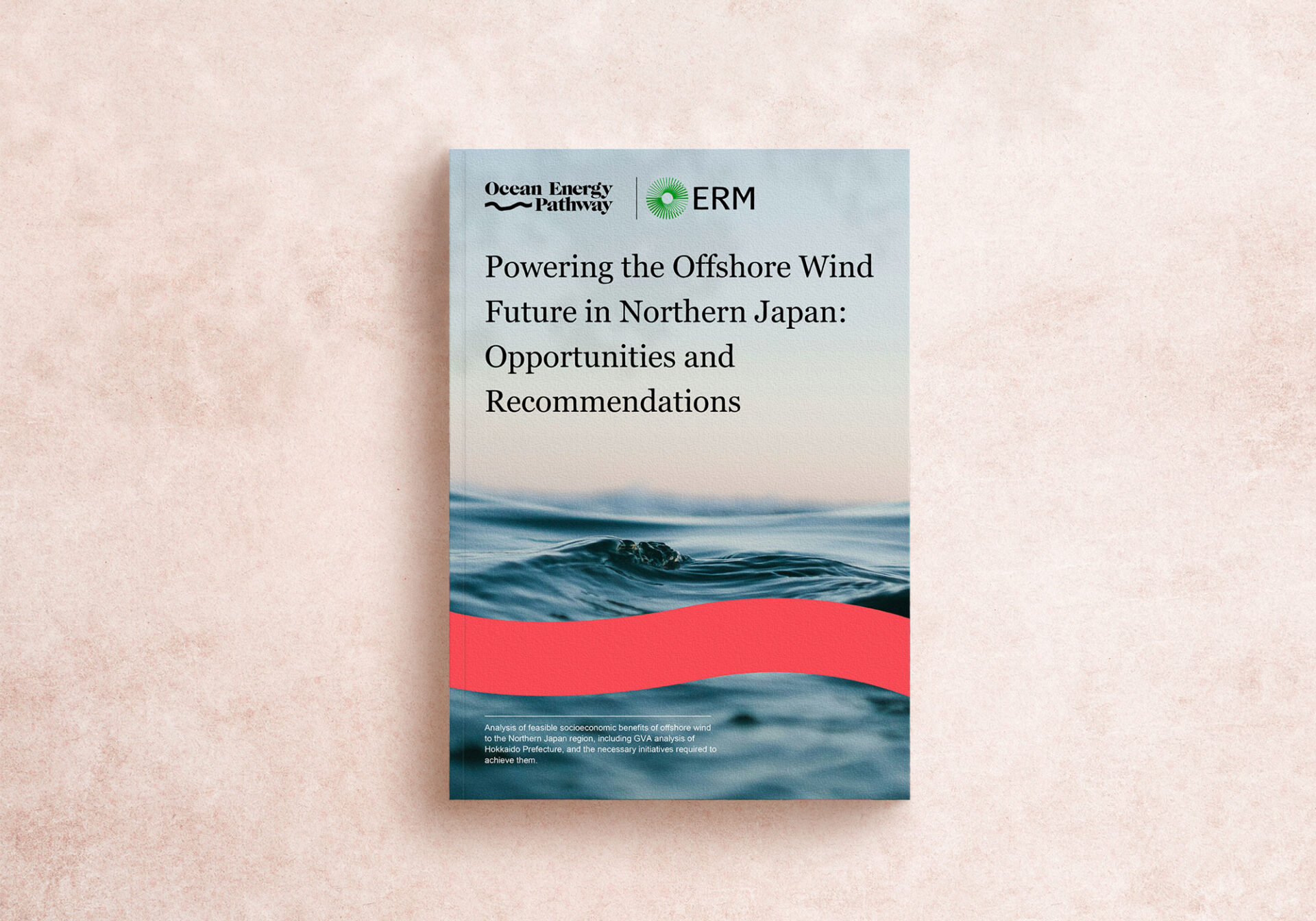

Hokkaido could add more than 2 trillion JPY and over 124,000 jobs to its economy by capitalising on its powerful offshore wind potential according to a new report by Ocean Energy Pathway and ERM.
Key takeaways
- Hokkaido’s offshore wind pipeline has the potential to inject up to 2.12 trillion JPY into the economy, while creating 124,000 new jobs.
- Through additional and targeted investments in O&M, floating wind supply chains and other initiatives, Hokkaido could triple the economic effects compared to development with current supply chain capabilities.
- Offshore wind projects across Northern Japan are expected to result in more than 10 trillion JPY in total expenditure, with local socioeconomic ripple effects worth trillions of yen.
Powering the Offshore Wind Future in Northern Japan: Opportunities and Recommendations
Download PDFOffshore wind presents a very significant opportunity for Northern Japan. This report presents an analysis of feasible socioeconomic benefits of offshore wind to the Northern Japan region, including Gross Value Added (GVA) analysis of Hokkaido Prefecture, and the necessary initiatives required to achieve them.
N.B. the Japanese language version of the report is available here.
The report finds that deployment of offshore wind presents a major socioeconomic opportunity for Hokkaido. Under a ‘possible’ scenario – based on the existing supply chain capabilities of Hokkaido Prefecture – offshore wind development could deliver up to JPY 641 billion in gross value added (GVA) and create nearly 45,000 jobs.
Under a more ambitious ‘potential’ scenario, which assumes additional targeted investments and local supply chain development, the economic opportunity rises to 2.12 trillion JPY in GVA, creating approximately 124,000 jobs.
The Northern Japan region (defined here as Hokkaido, the Tohoku region and Niigata Prefecture) has over 12 gigawatts (GW) of offshore wind in the pipeline, roughly equivalent to building 12 modern nuclear reactors. Only 250 megawatts (MW) of this potential is operational however, giving Northern Japan significant growth opportunities in the near future.
The results of this study are clear – offshore wind presents a very significant opportunity for Northern Japan. Not only does it increase our energy security, it plays a crucial role in revitalising local economies as well.
Omar Andrade, Senior Project Associate for Japan, Ocean Energy Pathway
Proposed Recommendations
To realise the benefits of offshore wind for Northern Japan as a whole, and unlock the greater socioeconomic impacts achievable under the ‘potential’ scenario, the report recommends a coordinated, region-wide industrial strategy. According to the findings, mobilising Japanese industry to support offshore wind will enable local supply chain initiatives and investments. In order to achieve this, the report puts forward five recommendations for Northern Japan’s offshore wind industry.
- Map industrial strength throughout Japan to help inform the planning of Northern Japan’s offshore wind supply chain development.
- Promote regional supply chain clusters to support the development of the offshore wind industry in Hokkaido and Tohoku.
- Encourage greater focus on long-term regional industry planning and development beyond the needs of individual offshore windfarms.
- Ensure policy delivers socioeconomic ripple effects for communities surrounding project areas.
- Achieve successful project build out through coordinated risk management.
In addition to the quantitative economic impact analysis for Hokkaido, the study also draws on more than 25 stakeholder interviews conducted across Northern Japan. These interviews explored regional industrial structures, policy developments, and both the challenges and opportunities facing the offshore wind supply chain. Together, these findings highlight that strengthening collaboration and coordination across Northern Japan is essential to developing a resilient and sustainable offshore wind supply chain. While current supply chain initiatives are expected to generate substantial benefits, the report makes clear that additional, coordinated action at a regional level is required to unlock the full opportunity of the ‘potential’ scenario.
While Hokkaido is already on track for significant offshore wind growth, realising the triple-value potential requires a long-term, holistic approach to developing the supply chain approach outlined in these recommendations. By fostering deeper collaboration between key stakeholders, Northern Japan can create a shared regional vision for offshore wind that maximises socioeconomic benefits for local communities.
The study shows that enhanced cross-prefectural collaboration will be essential for Northern Japan to fully realise the benefits of offshore wind. Such coordinated action could allow the region to play a central role in the offshore wind supply chain throughout Japan and the wider Asia-Pacific region.
Takayuki Shibata, Partner at ERM Japan