



India plans to deploy 25.5 GW of offshore wind across the country by 2030. At this level of deployment, the market is expected to reach a scale sufficient to support the development of key supply chain infrastructure. This includes production facilities for major components, such as nacelles, towers, blades, foundations, cables, and offshore substations, as well as port upgrades.
With Gujarat expected to install 5 GW of offshore wind, the state has a strong foundation to participate in a domestic offshore wind industry. Existing capabilities in engineering, project development, onshore infrastructure, and offshore fabrication provide an ideal platform for the development of a localised supply chain. Realising these opportunities however, will require
targeted support, partnerships, and coordinated planning, alongside clear roadmaps for long-term investment and decision making.
This report provides readers with a number of supply chain pathways, barriers, and recommendations to capitalise on the future growth of offshore wind in India.
Recommendations include:
- A co-ordinated, national approach to supply chain development should be established based on the regional supply chain specialisms of India’s main offshore wind states.
- Creating a suitable offshore wind port within Gujarat can be seen as a foundational investment.
- A stable pipeline should be supported by a framework that can offer incentives at the right level to crowd-in significant private investment in manufacturing.
- To ensure Gujarat can leverage its existing supply chain capabilities, an effort should be made to ensure that opportunities within the sector are clearly signposted.
- The R&D environment within Gujarat should be strengthened to allow technologies to be trialled under representative offshore conditions to help de-risk new approaches.
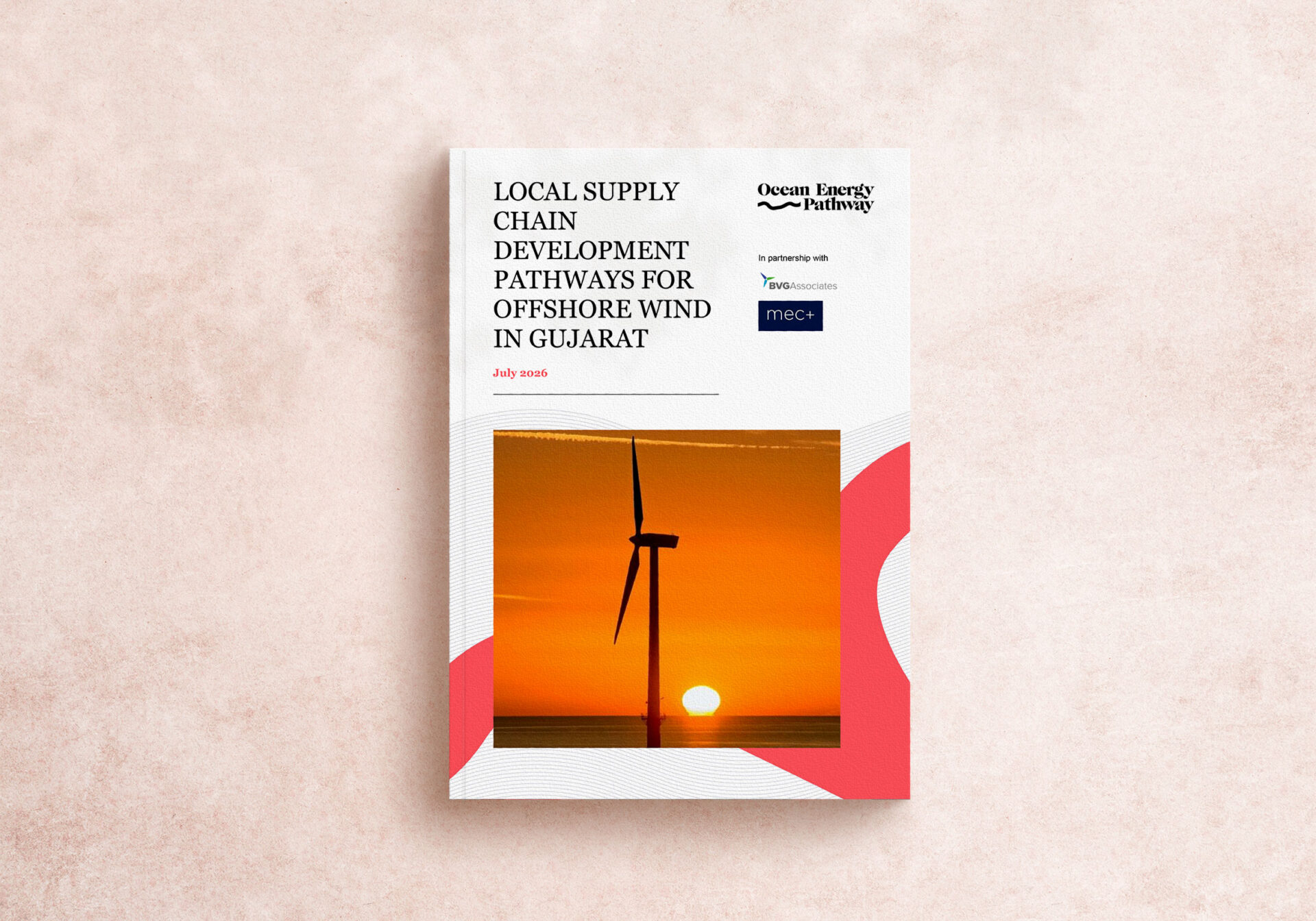
Local Supply Chain Development Pathways for Offshore Wind in Gujarat
Download PDFThis report puts forward a compelling case for the development of a localised offshore wind supply chain in Gujarat. By using its existing expertise across multiple sectors, the state can maximise its role in India’s future offshore wind industry.
The report puts forward three potential pathways for developing Gujarat’s offshore wind supply chain, based on the assessment of its capabilities. The pathways reflect different levels of ambition, investment, and supply chain focus:
- Core strengths: Under this pathway, Gujarat focuses on areas of the supply chain where there is strong logic for local delivery and where existing capabilities are well established.
- Strategic investment: This pathway involves large, targeted investments in enabling infrastructure and manufacturing facilities where local supply has clear advantages, for example in existing onshore wind manufacturing, or the state’s industrial strengths in steel and heavy manufacturing.
- Self-sufficiency: Under the self-sufficiency pathway, early and substantial action is taken to maximise local content and strengthen the local value chain.
Gujarat has strong foundations for the development of an offshore wind supply chain. Its ports, marine infrastructure, offshore oil and gas activity, heavy engineering base, and onshore wind manufacturing provide a solid platform that can be adapted for offshore wind. With clearer long-term policy signals, a visible project pipeline, and coordinated public–private investment, the state can progressively expand its role within the industry.